Tuesday, November 19, 2013

Clear waters.

This came up on my news feed this morning:

http://dailynewsdig.com/35-clearest-waters-world-swim-die/

It's a list of the 35 clearest waters in the world to swim in. There's no scientific basis to it, whatsoever, but they must have done something right, with Cayo Coco, Cuba placed fourth on their list.


Their picture doesn't even do it justice, so I'll just add my own here. (Any excuse to post more pictures.)


Cayo Coco, Cuba. By far, the clearest waters I have ever swum in.

Friday, November 8, 2013

Marine conservation in Cuba.

After my last post, a good friend of mine, also an avid scuba diver, asked me how the Cuban government had been able to maintain such pristine reefs throughout all these years. He pointed out that they would have had to start their conservation efforts a long time ago to achieve the results they have today.

It's an interesting question, and my friend is right. They did begin their marine conservation efforts years ago. I've been doing some research (rather limited, I'll admit) on how the reefs in Cuba have come to be the way they are, and what is keeping the levels of biodiversity so high in those regions. It's undeniable that, from a scientific standpoint, they are doing something right. And from what I've been reading, the U.S. has a lot to gain from ensuring that those reefs stay healthy.

I just found an interesting blog about marine conservation in Cuba on the Environmental Defense Fund (EDF) website. EDF is a US based organization whose aim is to preserve earth's natural systems. They focus on a wide range of topics like climate change, clean air, oceans, etc. They even have an entire team dedicated to working with Mexican and Cuban scientists, so as to collaborate on the work of protecting the bodies of water which affect all three nations - the Gulf of Mexico, the Florida Straits, and so on. They're all critically connected, ecologically speaking.

Anyway, the director of EDF's Cuba program, Daniel Whittle, posted a blog entry on small fishing communities along the southern coast of Cuba. He talks about marine protected areas (MPAs), regional fisheries management, and community-based, sustainable fisheries. It's worth a read, especially for marine ecologists and biologists.

On a side note: I totally did not realize that the Gardens of the Queens national park in Cuba was the largest marine park in the Caribbean. Right now, there is even an initiative to expand it. That's a pretty big deal.


Saturday, October 26, 2013

Jardines de la Reina.

A few days ago, I came across this video on youtube of some pretty amazing scuba diving in Jardines de la Reina, or the Gardens of the Queen, in Cuba. Anderson Cooper went on assignment for 60 Minutes, and got to scuba dive the reefs down there, which are basically untouched by tourists (1000 divers per year, maximum). Don't get me started on how jealous I am that Anderson Cooper got to go there, but let's be real - it's Anderson Cooper. Everybody loves Anderson Cooper. I can't even be mad.

Anyway, back to real life. The Cuban reefs in the video are similar in some ways to the barrier reef just off of Belize. When I was a junior in high school, my dad, my brother, and I took an amazing trip to Ambergris Caye, Belize. We saw a lot of similar species to the ones in the video. Huge groupers, parrotfish, reef sharks, etc. Seeing the Cuban reefs in the video brought back all those sweet memories.

After watching the 60 Minutes clip, I stumbled upon another video about environmental conservation efforts in Cuba, with a large portion dedicated to the pristine condition of the reefs. It's called "Cuba: the Accidental Eden", and it's a PBS video totally worth 50 minutes of your life. If you like reefs, scuba diving, and/or Cuba (among many other things), you should really watch it.

These are just a couple photos of the Cuban reefs I found online (taken from the Environmental Defense Fund website). I especially like the second photo, with the sharks lurking in the background.

A Black Grouper.

A Queen Triggerfish.
Also, here's a hot tip from 11 year-old Lindsay: Don't paint your nails with shiny, blue nail polish and then go snorkeling, and feed bread to triggerfish in the Red Sea. THEY WILL BITE YOU.
You can thank me later.

Friday, October 18, 2013

Life's a beach.

Day two of our Cayo Coco trip consisted of beach-going, scuba diving, and reliving my marine biology days.

In the morning, a group of us ventured out to a dive shop at another hotel in Cayo Coco, hopped in a little speed boat with a couple of their SCUBA instructors to lead the way, and dropped down for a wreck dive just off the shore. I won't bore you with another picture of the stunning shoreline of Cuba (haha, just kidding, yes I will!).
The lobby of the other hotel, where the dive shop was.
A wall map of Cayo Coco and some of its dive sites.
Unfortunately, I don't have any pictures of our boat trip out to the dive site (didn't want to risk dropping the camera in the water!), or any underwater pictures from our dive, but this was our boat. The tide was in, and the waves were high. And really fun.


Big waves!
We boated out to the dive site about ten minutes away, and dropped down for a quick, but fun, wreck dive. The wreck was an intentionally-sunk fishing boat, which was intended to create an artificial reef where there isn't one.  So far, it's not a very developed reef, but there are a few regular fish inhabitants, and the beginnings of a few species of coral. These kinds of artifical reefs take years to grow, but I must say, it is very forward thinking for the Cuban marine conservation groups to initiate projects like this.

I managed to find a picture of our wreck dive site from the Cayo Coco dive center website!
The fishing boat at the bottom of the sea.

You can see the early formations of coral on the outside of the boat, and the different species of fish it attracts. That, my friends, is how you build a reef. Being the geek that I am, I find it refreshing to see that governments are taking an active role in protecting their oceans and marine ecosystems, which are more important than most people think. (Once a biologist, always a biologist.) Maybe one day I'll get to go back to that dive site and see how much it's grown.

Anyway, after our little SCUBA diving excursion, a group of us drove out a little ways to another beach, Playa Pilar, which, as I mentioned in one of my first posts, is probably the nicest beach I've ever seen.

The drive out to Playa Pilar from the back of a pickup.
Playa Pilar.


This is just a boring picture of a mangrove swamp...
...UNTIL YOU ZOOM IN.
There were some nice views along the way. Mangrove swamps GALORE. When I was in fourth grade, in Jeddah, Saudi Arabia, I did a research project on mangrove swamps. There was so little information in our library about them (this was before the internet came to town...) that I had a hard time writing about that particular ecosystem. To see miles of untouched mangrove swamps in Cayo Coco, Cuba was pretty incredible. The only other time I can remember seeing mangroves that extensive was when I was off of a remote island in Indonesia. And there were no flamingos in Indonesia, I might add.

The biologist in me was geeking out all day.
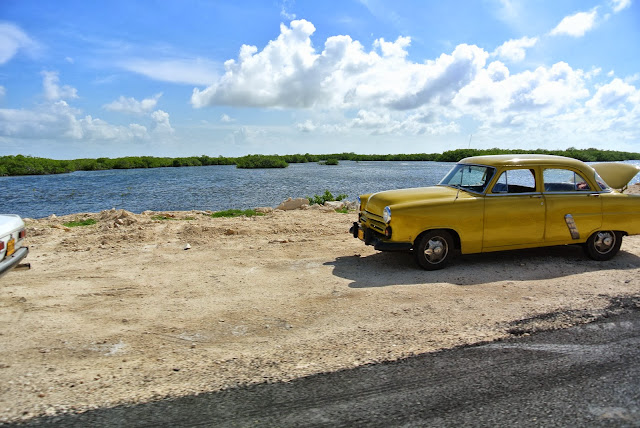
Ahh, Cuba.

Monday, September 16, 2013

Cayo Coco, Day One.

If you ever find yourself in Cuba, looking for something to do for the weekend, hop in a car for 6 hours, and drive to Cayo Coco. Seriously, you will not regret it.

Cayo Coco is a caye just northeast of the mainland of Cuba, with a handful of resorts scattered around the island. Our home for the weekend was called Hotel Iberostar, and it was great - decked out with pools, a spa, a couple of nice dining areas, a mini gym, a cigar lounge and direct access to the beach. There were even daily and nightly activities to partake in, had we so desired (think water aerobics and evening dance shows). The hotel was also full of Europeans and Canadians. Lots of Canadians.

The entrance to the hotel.
This sweet car was a permanent fixture in the lobby.
Of all the traveling I've done, not much of it has been spent at resorts, so it was pretty exciting to be in an "all-inclusive" hotel. You can not imagine my joy at discovering that we could get hot dogs and french fries at any time of day. The last time I was at an all inclusive hotel was when Daniel and I went skiing in Uludag, Turkey. While it's incredibly convenient to have everything taken care of, it's just a style of traveling to which I am unaccustomed. Needless to say, it was nice.

After we had dropped our stuff off in our rooms, we proceeded to do things in order of greatest importance. So, obviously, we hit up the restaurant by the pool for hot dogs and french fries, first. When we had finished eating, a guy came around to our table with a hawk perched on his arm, asking if we wanted to pet and hold the hawk. It took us about a second to think that one over.

Hawks = Awesome. Also, check out my shiny, new engagement ring! :)
Our next mission: Find the beach and do a whole lot of nothing.
MISSION ACCOMPLISHED.
Missing this view, right about now.
As you can imagine, we were pretty spent after our tough afternoon of frolicking in the ocean. We cleaned ourselves up, and made our way to the main restaurant area for some dinner. We managed to catch the last little bit of the hotel evening show, and I stopped in at the hotel gift shop to pick up some post cards, but we didn't stay up too late. Much to our excitement, we had some scuba diving to look forward to the next morning!

Monday, September 2, 2013

A 90 mile swim.

As I type, there is a woman in the final stages of her swim from Havana, Cuba to the Florida Keys. If she makes it, Diana Nyad will be the first person to have made the 90 mile swim without the use of a shark cage, setting a pretty incredible record. She calls it her "Xtreme Dream".

All I could think about when I saw the headline was how staggering a task that really is. I am no long distance swimmer, so I can't say I know what she's going through. I have, however, battled the currents of the Cuban waters while scuba diving along Havana's coast, so I can attest to the fact that swimming against those waters is unbelievably difficult. No doubt, it is beautiful, but those currents are strong.

For example, on one of my last days in Havana, a few of us were hoping to go for a dive just off of the rocks in Havana. It was a sunny day, but the waters were pretty rough, so we weren't sure if we should go. Ultimately, we were up for an adventure, so we just decided to go for it.

That dive was easily the hardest dive I've ever been on.

Getting in the water proved difficult from the get-go (that should have been our first sign). The waves were mildly rough, but we jumped in, put our gear on and had a solid drift dive. The plan was to drift along the coast for a couple hundred meters (about 50 minutes), and resurface where we could climb out in an "easier" location (with some rudimentary steps leading out of the water). As it happened, we missed the exit point by about 50 meters. We inflated our BCDs and surface kicked against the current for what seemed like hours. Most of the time, it felt like we weren't even making any progress. But alas, we made it to our originally planned exit point. We got battered by waves coming in, and took a few tumbles. Once we reached the exit spot, we realized that there wasn't really an exit (*facepalm*). So, we threw our gear over a ledge, hopped over a wall, and walked across a wave-bashed cove, bracing ourselves whenever a big wave hit. We finally reached a spot where we could lift ourselves up and onto the street.

The dive information from someone's logbook that day.

It is no surprise to me that there has yet to be a successful attempt (perhaps today is the day?) at swimming the 90 miles between Havana, Cuba and the Florida Keys. Having experienced even slightly the natural elements of those waters, I am even more staggered by Diana Nyad's attempts. Seriously, more power to her. This is her website, if you want to follow her in her last few miles.

4pm Update: Just before 2pm Eastern time, Diana Nyad becomes the first person to successfully complete the swim from Havana, Cuba to the Florida Keys without the aid of a shark cage.
http://us.cnn.com/2013/09/02/world/americas/diana-nyad-cuba-florida-swim/index.html?hpt=hp_t1

Saturday, August 3, 2013

The Long Drive.

On my third day in Cuba, Daniel and I, with a couple of good friends, made the long drive from Havana to Cayo Coco, where we planned to spend a few days relaxing, scuba diving, sun-bathing, and beach-going (I know, it's a hard life). Cayo Coco is an absolutely beautiful resort town of the same ilk as Varadero, just way, way farther away. As we drove the 6 hours through the Cuban countryside, we passed through a few towns and got to see some areas of untouched beauty. Some of the landscape could have been right out of Jurassic Park.

We tried to get a few snapshots along the way, hoping to capture the atmosphere of what we were seeing. A moving car made that difficult, but we did get a few (or a lot). 


I can hear John Williams as I type.
Spot the two rancheros! ^^^


Whenever I visit a new place, I like to see what life is like for the people that live there. I mean real life. I'm not the kind of person to pack as many tourist attractions and museums as possible into each day. I would much rather roam around local side streets or villages, watching people in their everyday routines. That kind of stuff says more about a culture than anything you can read in a Lonely Planet travel guide. (I don't have anything against tourist attractions - that's just not where the gold is.)

Our road trip afforded us a view into a part of Cuba (albeit a small part) about which I knew nothing.
Here are some photos from our road trip(s), for your browsing...

It wouldn't be Cuba if there weren't pretty cars!

A Cuban rest stop.
One of the first towns we passed through.
Cayo Coco...in the distance.

In Cuba, they don't mess around with transportation. Horse and buggy, bike, sidecar, classic car. You name it, they've got it.
You can add tractor to that list.

Incredible artwork in Ciego de Avila, one of the towns we drove through on our way to Cayo Coco.
A Cuban Main Street.

Traffic jam.

The land bridge we crossed in our final stretch to Cayo Coco.
Cayo Coco. Where all your dreams come true.

             On the way back...

The most retro phonebooths I've seen in any city (sorry, London).

A car that, as you can see, literally sparkled. Somebody was a little excited...

Just some explosives, nbd.